Showing posts with label energy. Show all posts

Saturday, December 14, 2024

Wrong and Strong, Seemingly


Steve M in his No MoreN Mr. Nice Blog makes a very good point.

Remember the end of Donald Trump's 2024 campaign? The town hall that concluded with Trump dancing onstage for a half-hour? The anecdote about Arnold Palmer's penis? The Madison Square Garden rally -- in a state Trump had no chance of winning -- that turned into a racist, profane grievance-fest? The fry cook and garbageman cosplay?

We thought the wheels were coming off the bus. We thought the public would recognize Trump's obvious unfitness to serve. Instead, he won the election, won the popular vote for the first time, and received more votes and a greater percentage of the popular vote than he had in his first two elections.

So am I saying that the 2024 Trump campaign wasn't a shambolic mess? No. In many ways, it was a shambolic mess. But it appears to have been a shambolic mess in such an aggressive, in-your-face way that millions of voters responded positively to the preposterousness of it all. They liked Trump's arthritic dance moves and granddad music playlist. They decided, somehow, that the unapologetic way Trump would say any WTF thing he felt like saying meant he was just the crazy bastard America needed to take on the bad guys.....

It seems to me that voters don't care what Trump is doing -- they just like the fact that he's doing whatever he's doing vigorously and forcefully. Once again, it appears that a famous 2002 Bill Clinton remark was correct:

"When people are feeling insecure, they'd rather have someone who is strong and wrong rather than somebody who is weak and right"...

Trump is proving that there's apparently no limit to how wrong you can be and still get the benefit of seeming strong.

That is the only way- or at least the best way- to make sense of Trump bragging about this, and getting away with it.


In the video, Trump comes off as a strong, first-class dealmaker, as he typically- successfully- tries to do. Though not the paragon of objectivity, Climate Power- in what has never been refuted- two months ago explained 

In April  2020, Donald Trump cut a deal with Vladimir Putin, Saudi Crown Prince Mohammed bin Salman, and OPEC to intentionally increase oil prices and bail out his biggest oil donors after a price war between Russia and the Saudis sent oil prices plunging.

Trump cut the deal after his biggest fossil fuel backers lost billions from their net worth in just weeks, including Trump’s most crucial oil donor, Harold Hamm, who convinced Trump to bail the oil industry out after he lost $3 billion in days. 

Hamm leveraged his years of support for Trump, convincing him to host a whole roomful of oil executives at the White House to hash out the deal. Attendees included Kelcy Warren, Jeff Hildebrand, Vicki Hollub, and, of course, Harold Hamm. 

If any of those names sound familiar, that’s because they all responded to Trump’s April request for $1 billion by cohosting multiple fundraisers for him over the past six months. That includes the CEO who told Trump that she was upset at the FTC for requesting her cell phone record while they were reportedly investigating her over allegations of potential collusion with OPEC to raise gas prices....

 A USA Today editorial asked, “Amid coronavirus pandemic, why is Donald Trump trying to push up fuel prices?”… The editorial board wrote that  “the most unambiguous winners of higher prices are countries like Russia and Saudi Arabia, not the United States, which is still a net importer. What’s more, his move attempts to help oil companies by imposing higher costs on U.S. consumers, workers and fuel-reliant businesses.”

Trump boasted "said we got to get it up a little. I called Russia and the King of Saudi Arabia. We had a three-way call and we cult back on the oilbecause it was so incredible- helped fill up the Strategic national reserve" (i.e., Strategic Petroleum Reserve).  

There was little or no downside for the President because he declared victory as Democrats chose not to highlight the issue. It was a twofer for Trump- pleasing both his energy donors and boosting the economy of one of his favorite countries, Russia. Six months later, Saudi Arabia threw $2 billion dollars to son-in-law Jared Kushne, thereby consummating what Trump might satisfyingly call a "three-way."



Sunday, July 03, 2022

Owners Win, Again


Let's give credit where credit is due. While most of us were watching reproductive rights demolished and gun rights sanctified.....


Six days later, as reported by the Texas Tribune the US Supreme Court ruled

that the Environmental Protection Agency does not have broad authority to require states to decarbonize their electricity sectors, a decision that is expected to dramatically slow the United States’ ability to reduce greenhouse gases and mitigate the effects of climate change.

The court’s 6-3 ruling on a case sparked by Texas and 16 other states — which addressed an Obama-era regulation aimed at coal-fired power plants, one of the biggest sources of greenhouse gas emissions in the nation — was a blow to President Joe Biden’s plan to reduce U.S. emissions and meet the country’s goals under international agreements.

Texas Attorney General Ken Paxton was among 17 Republican state attorneys general who sued the EPA over an Obama-era regulation known as the Clean Power Plan, which never went into effect. It was repealed and replaced by what was called the Affordable Clean Energy rule under the Trump administration....

The decision, which limits EPA’s authority to implement regulations that cause shifts in fuel sources for electricity generation, will make it difficult for the U.S. to do its part to meet a 1.5-degree Celsius target that scientists have said is key to preventing extreme effects of climate change, experts said.

“We have to act rapidly to cut emissions in order to avoid the worst impacts of global warming,” said Luke Metzger, executive director of Environment Texas. “And it’s unlikely that the natural or economic environment of these coal plants will happen fast enough to meet those emission goals.”


As a prediction, Pierce's tweet was accurate but arguably underwhelming because announcement of the ruling in West Virginia v. EPA was obviously upcoming, and expected to be decided in favor of the plaintiff. However, Pierce understood the wide-ranging implications at stake, including the "ability of the executive departments to regulate, well, anything, and that’s the one the Court’s owners really want." The Texas Tribune explains

The ruling could also open the door for more aggressive challenges to federal regulations at any agency, administrative and environmental lawyers said.

“I do think you’re going to see other federal agencies sit back [as a result of the case],” said Anne Austin, an environmental lawyer who was an assistant administrator for the EPA’s Office of Air and Radiation during the Trump administration. The ruling may cause federal agencies beyond the EPA to narrow regulations to avoid what could now be “shaky legal ground.”

“Federal agencies are more likely to be challenged [in court],” added Austin, a former EPA Region 6 administrator. States that want to prevent certain federal regulations are likely to take a broad view of the majority’s opinion, she said.

Once upon a time- three, four years ago- there was a major push for a Green New Deal. Those days are way gone, and much more may be headed for the chopping block.


                                            HAPPY INDEPENDENCE DAY


Friday, June 17, 2022

Taking Advantage


By contrast, this tweeter demonstrates that annual production by USA oil companies has been higher under President Biden than under the previous five Presidents. That doesn't prove that the incumbent has done a better job at encouraging oil production than the others, nor that he has done a particularly good job.

However, it does prove that he is not the problem. Let us recall that in April of 2020, a mere five months before he left (kicking and screaming) the presidency

As the Organization of the Petroleum Exporting Countries and its allies came to an agreement on a record cut in oil production, U.S. President Donald Trump may have struck his “biggest and most complex deal,” according to oil expert Dan Yergin.

“What was so interesting — among many, very interesting things in this unprecedented event — was the turnaround, the pivot by Donald Trump,” Yergin, who is vice chairman at IHS Markit, told CNBC’s “Street Signs” on Monday.

Just a few weeks ago, Trump had said the early-March plunge in oil prices were “good for the consumer” as it meant lower gasoline prices. That drop in crude prices had been triggered by an oil price war between Saudi Arabia and Russia after Moscow rejected a proposal by OPEC to cut 1.5 million barrels of production per day.

The sharp decline in oil prices spurred giant capex and job cuts across the U.S. shale industry, which has some of the highest production costs in the world.

But Yergin said: ”(Trump) came to see this as a national security issue, also an employment issue, and a very important factor in the U.S. economy … and he just jumped in.”

Let's hope this Yergin character, a member of the National Petroleum Council who claims less oil production is good for national security, never gets close enough to sniff a governmental policymaking position. Expansion of renewable energy is good for national security. Cutting oil production internationally raises costs to the consumer and most assuredly does not promote national security.

But Jordan and company are little interested in reducing the price of fuel and other forms of energy. If they were, they wouldn't have been unanimous in opposing (as did four Democrats) in the House of Representatives the Consumer Fuel Price Gouging Prevention Act, which "would grant the president authority to issue emergency energy proclamations and make it illegal to increase gas and energy prices in excessive and exploitative ways. It would also expand the Federal Trade Commission's power to investigate and address possible price gouging by oil and gas companies." (It's expected to die in the Senate.)

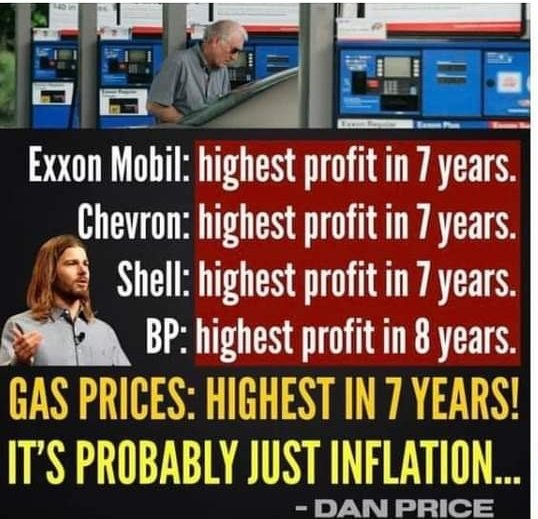
With gas in short supply, less can be sold and yet, miraculously, oil companies are reaping record profits. There is nothing like taking advantage of an international crisis to gouge the public. So it must be Biden's fault.

Rumor has it that there will be elections throughout the country in November. Most Republicans are standing in firm, many in enthusiastic, support, of a fellow who as President tried to get the Vice President killed and to prevent the peaceful transfer of power. It shouldn't be surprising that, with high gas prices imperiling a Democrat majority in Congress, they would be standing with Big Oil and against the American public.


Thursday, March 10, 2022

Replace Woke With Populist


Please don't. Just don't.

It's a wonder that Joe Biden and "other Democrats" have been elected, for while gasoline prices soar, Politico reports

Some Democrats are seizing on the current crisis to renew their argument that the way to cut America’s dependence on foreign oil is through renewable energy and reduced consumption, not by boosting America’s own production of oil and natural gas, given the existential threat of climate change.

Biden said Tuesday that the current situation should “motivate us to accelerate the transition to clean energy,” a refrain other Democrats have echoed this week. Biden’s failure to enact a sweeping climate and social spending plan last year that he spent months negotiating left many environmentalists demoralized.

You're kidding, aren't you? Few motorists roll into a gas station, sees the cost of gas up 15 cents from the previous week and higher than it ever was while Donald Trump was president, and think  "what we really need now is renewable energy," "thank God for solar energy," "environmentalists have the answer," or "clean energy today!"

Voters see unaffordable gas and they want to know who to blame.  Admittedly, it's necessary to set the record straight by reminding people that the USA was awash with oil in 2020, even 2021, because fewer people than normally were driving. (And the war in eastern Europe has disrupted the market.) But it's not enough. At least this is a start:


The press secretary is on the right (actually, left) track. Shelling out their earnings on gas, Americans don't want to hear about the Green New Deal or climate change.  They're looking for someone or something to to hold accountable.

On Thursday, one prominent GOP senator, wary the American people might credit President Biden for cutting off energy supply from Putin's Russia, tweeted "The price of gas increased by 75% since Biden became president *before* Biden blocked oil imports from Russia."

Democrats need to find a counter-narrative, and, assuming they'd like to win more than a few elections in November, it must not be environmentalism because the finger-pointing must not be left to Republicans. 

Fortunately, Democrats can assess responsibility while pursing the effort, through legislation and/or executive orders, to rein in fossil fuel interests to combat climate change. One possibility is through breaking up monopolies in the energy industry. Another is suggested by Sam Seder, beginning at 5:42 of the video below:


Fannie Lou Hamer famously said "I'm sick and tired of being sick and tired."  The American people are sick and tired of being ripped off, abused, and cheated. They will blame Democrats or the energy industry. Democrats must decide which they'd prefer.


Saturday, March 05, 2022

Pitch Perfect


The Montana Standard notes that the Biden Administration "announced it would continue its leasing pause as it retooled the way it calculates climate change costs associated with fossil fuels extracted from public lands." More recently

Tensions hit a new level this week as Congress turned its attention to oil and gas supply challenges exacerbated by Russia’s war in Ukraine. Demands for domestic oil production sparked a flurry of congressional bills.

At issue is a now 15-month pause on federal land oil and gas leases, initially triggered by an executive order on Jan. 27, 2021, as the new administration reviewed climate impacts of fossil fuels from public lands. That pause segued into a legal dispute in 14 states with Republican governments, Montana included, suing over the pause.

“There were leases the Trump administration had all prepared and ready to go for first quarter 2021, and the Biden administration came in and put a halt to it,” said Kathleen Sgamma, Western Energy Alliance president. “There has not been a lease sale in Montana for all of 2021 and now there won’t be one for the first quarter of 2022.”

On Thursday, a Fox News White House correspondent, noting the President had "talked about increasing domestic manufacturing to bring down prices on inflated items," asked the Press Secretary "so why not apply the same logic to energy and increase domestic production here?" Jen Psaki replied “Well, there are 9,000 approved oil leases that the oil companies are not tapping into currently.  So I would ask them that question,”

One reporter raised the same issue on Friday after he spoke to the American Petroleum Institute and Psaki responded

The fact is that onshore alone at the start of this year the industry had more than 9,000 unused permits to drill in the United States.... and of the more than 37 million acres under lease offshore nd onshore to the oil and gas industry, nearly 60% are currently non-producing...

Overall, what we need to do here is reduce our dependence on oil. Europeans are doing that, we're doing that, and what I think we're all going through now is this discussion of banning oil imports and the volatility in the global market- oil markets- is a reminder of that. So there's no shortage of drilling leases than can be used domestically to enhance production in this moment. The oil and gas industry is literally sitting on stockpile leases and permits.

That's good journalism when the media confronts a spokesperson for the President about a crucial issue and then follows up on it at the next available opportunity.

Though informed and prepared, Jen Psaki on this answer alone should not turn Chris Meloni's "perhaps" to "undoubtedly." But surely she's in the running.


Tuesday, February 09, 2021

Legitimate Face-Off


A colloquy between presidential Press Secretary Jen Psaki and Fox News' Peter Doocy about energy policy, especially Keystone XL, provoked a whole raft of tweets from both supporters and opponents of the Administration, though the former were more numerous. Transcript of the entire news conference is here, that of the more significant portion below, and video of the entire exchange between Psaki and Doocy further below..


Q    So how about this: The Laborers’ International Union of North America said the Keystone decision will “cost 1,000 existing union jobs and 10,000 projected construction” jobs.

MS. PSAKI:  Well, what Mr. Trumka also indicated in the same interview was that President Biden has proposed a climate plan with transformative investments and infrastructure and laid out a plan that will not only create millions of good union jobs, but also help tackle the climate crisis.

And as the President has indicated when he gave his primetime address to talk about the American Rescue Plan, he talked about his plans to also put forward a jobs plan in the — in the weeks or months following.  And he has every plan to do exactly that.

Q    But there are people living paycheck to paycheck.  There are now people out of job once the Keystone pipe — out of jobs once the Keystone pipeline stopped construction.  It’s been 12 days since Gina McCarthy and John Kerry were here, and it’s been 19 days since that EO.  So what are these people who need money now — when do they get their green job?

MS. PSAKI:  Well, the President and many Democrats and Republicans in Congress believe that investment in infrastructure — building infrastructure that’s in our national interests, that boosts the U.S. economy, creates good-paying union jobs here in America, and advances our climate and clean energy goals — are something that we can certainly work on doing together.  And he has every plan to share more about his details of that plan in the weeks ahead.


Defenders of the Administration came out in droves, the tweets including:

'Present your data': Jen Psaki smacks down Peter Doocy's gotcha question on Keystone Pipeline jobs

Man, @PressSec came with the damn recipts for Doocy's bad faith question. When you get a heckler at a comedy show, the problem isn’t what the heckler is saying, it’s the nervous, stomach-churning dark energy they bring into the room.

Psaki working on a level or two above Doocy.

This is called "dropping a Doocy."

I’m gonna start calling that feeling a Doocy.

Peter Doocy is clearly a masochist — a normal person would be tired of being smacked down by Psaki on a daily basis by now

Watching Jen Psaki call bs on Peter Doocy is an unrivaled daily pick-me-up.

 "You come for the queen, you better not miss." There is no monarchy in the USA and idolizing someone to the extent of calling her a "queen" should be disturbing.


It should be but it won't, because that's how it is these days. Tweets from critics of the Administration, praising Doocy and blasting Psaki, were about as bad.  

Jen Psaki's response was in fact fairly good. In her final response, she was able to go on for 71 words, effectively denying the mainstream media an opportunity to notice she hadn't answered the question. On Twitter, the left (without a touchdown scored) ignored the issue of energy on environmental policy, instead spiking the football: smacks down; damn receipts; working on a level above a daily pick-me-up; Doocy a masochist; if you come for the queen, better not miss.

Except that Doocy actually asked a well-thought out series of questions about an important topic.  Psaki answered the question in the manner, under the circumstances, she should have. Now that Donald Trump is out of office, reporters should not lay down and act as sycophants to the Administration.  

The response to the practice of the press secretaries of the previous President to avoid questions, insult reporters, and lie to the American people is not to be a stenographer to this one.  Good for Peter Doocy and Jen Psaki; not so good for the partisans who count this as a win or loss for their side.


Monday, October 08, 2018

Do The Right Thing


One of the Washington Post's columnists in September 2017 wrote a piece entitled "Saudi Arabia wasn't always this repressive. Now it's unbearable" and announced that he was leaving the country. In an editorial Thursday, the Post noted

he entered the kingdom’s consulate in Istanbul on Tuesday to take care of what should have been routine paperwork. Saudi Arabia says he then left. His fiancee, waiting for him, says he did not, and he cannot be found. Turkey says it has seen no sign that he left the building. Mr. Khashoggi, a contributor to The Post’s Global Opinions section, appears to have disappeared, and we are worried.

Mr. Khashoggi is not just any commentator. Over a long career, he has had close contact with Saudi royalty and knows more than most about how they think and function. His criticism, voiced over the past year, most surely rankles Mohammed bin Salman, who was elevated to crown prince last year and has carried out a wide-ranging campaign to silence dissent while trying to modernize the kingdom. Among those in his prisons for political speech are clerics, bloggers, journalists and activists. He imprisoned women who agitated for the right to drive, a right that was granted even as they were punished.

Turkish officials now are claiming that while in the embassy, Kashoggi was murdered and his body dismembered and removed in boxes. Amnesty International termed the possibility

an abysmal new low. Such an assassination within the grounds of the consulate, which is territory under Saudi Arabian jurisdiction, would amount to an extrajudicial execution. This case sends a shockwave among Saudi Arabian human rights defenders and dissidents everywhere, eroding any notion of seeking safe haven abroad.

Robin Wright explained

When we spoke last November, Khashoggi compared the Saudi monarchy to the Iranian theocracy. “M.B.S. is now becoming the supreme leader,” he said, a reference to Iran’s top authority, who has veto power over every branch of the government. Since his father became king, in 2015, M.B.S. has consolidated his hold on the five major sectors of power, serving as minister of defense, head of a new economic council, and chief of the royal court. “He is very autocratic and totally illiberal,” Khashoggi told me in August. “I worked for the government for four or five years. I never thought I’d be arrested, but then I thought I might. That’s why I left.” Khashoggi’s status became ever more precarious as his critiques of the monarchy sharpened in recent months.

As of Monday morning, the report is not confirmed. However, if it is, the way forward should be obvious. President Trump has

expanded US military assistance to his Saudi and UAE allies – in ways that are prolonging the Yemen war and increasing civilian suffering. Soon after Trump took office in early 2017, his administration reversed a decision by former president Barack Obama to suspend the sale of over $500m in laser-guided bombs and other munitions to the Saudi military, over concerns about civilian deaths in Yemen. The US Senate narrowly approved that sale, in a vote of 53 to 47, almost handing Trump an embarrassing defeat.

In late 2017, after the Houthis fired ballistic missiles at several Saudi cities, the Pentagon secretly sent US special forces to the Saudi-Yemen border, to help the Saudi military locate and destroy Houthi missile sites. While US troops did not cross into Yemen to directly fight Yemen’s rebels, the clandestine mission escalated US participation in a war that has dragged on since Saudi Arabia and its allies began bombing the Houthis in March 2015.

The war has killed at least 10,000 Yemenis and left more than 22 million people –three-quarters of Yemen’s population – in need of humanitarian aid. At least 8 million Yemenis are on the brink of famine, and 1 million are infected with cholera.

This war has been a humanitarian disaster, one that President Obama never should have gotten the USA involved in it. President Trump should not have made a bad situation much, more worse, as is his wont.

In times past, suspicion abounded that the US government was cozy with Riyadh because as the world's largest exporter of petroleum, it had an outsize influence on OPEC and thus the worldwide price of oil. However, the USA is now awash in oil, many advanced nations have made major, successful investments in renewable energy, and playing nice with the kingdom is no longer necessary.

Last week, President Trump actually said something constructive (though a little naive) about Saudi Arabia when he stated

We protect Saudi Arabia. Would you say they're rich? And I love the king, King Salman, but I said "King, we're protecting you. You might not be there for two weeks without us. You have to pay for your military."


If it is determined the Saudis likely murdered Jamal Kashoggi, it will be time for Trump to put up or shut up.  That's a slender reed to hold on to, but with Donald Trump finalizing control of his party and extending control over the entire nation, it is at present the best hope.


Share |

Sunday, December 04, 2016

Oil Man


On Saturday, Bernie Sanders tweeted "The United States has a decision to make: do we continue the exploitation of Native Americans or do we treat them with dignity and respect?"

I think the decision has been made.  PBS reports

President-elect Donald Trump supports completion of the disputed Dakota Access oil pipeline in the Midwest, based on policy and not the billionaire businessman’s investments in a partnership building the $3.8 billion pipeline, according to an aide’s memo.

Spokesman Bryan Lanza said in a memo this week to supporters that Trump’s backing for the pipeline near a North Dakota Indian reservation “has nothing to do with his personal investments and everything to do with promoting policies that benefit all Americans.”

It's possible, given Trump's fondness for fossil fuels and the corporations making a killing off them. Still

Trump’s most recent federal disclosure forms, filed in May, show he owned a small amount of stock in Texas-based Energy Transfer Partners, the pipeline builder, and at least $100,000 in Phillips 66, an energy company that owns one-quarter of the pipeline.

Trump spokeswoman Hope Hicks said in response to an AP story last week that it is her understanding Trump recently sold his Energy Transfer stock, but she provided no details. Neither Hicks nor other Trump aides have responded to repeated requests for information since then.

Given the cabinet nominations of Steve Mnuchin, Elaine Caho, Tom Price, Wilbur Ross, Betsy DeVos, Mike Pompeo, Jeff Sessions, and even Nikki Haley, Trump's preference for further enriching and empowering fossil fuel companies may be as much an ideological preference as looking out for #1.   Support for the Dakota Access oil pipeline dovetails nicely with both priorities.

With America's Populist, Donald Trump, to take office on January 20, 2017, the dignity and respect Bernie Sanders is looking for will be in short supply, other than for defense contractors, Wall Street firms, fossil fuel companies, and the like.  Activist and author of "The Militarization of Indian Country" Winona LaDuke goes into some detail about pipeline company Enbridge, then concludes

So I'm asking American labor to stand with us and to say "we want peipelines, we want infrastructure that goes for people, that goes for communities and not for companies that are going to destroy our environment and cause more climate change to our planet."


Share |

Tuesday, January 06, 2015

The Chinese Await


Republicans aiming to bring to a vote on Friday approval of the northern portion of the Keystone XL pipeline expect passage with 63 votes, four short of the number necessary to overturn a presidential veto. The President and press secretary Josh Earnest remain noncommittal, though Obama has stated Keystone would be “very good for Canadian oil companies, and it’s good for the Canadian oil industry, but it’s not going to be a huge benefit to U.S. consumers. It’s not even going to be a nominal benefit to U.S. consumers.”

The possibility that the President would sign the legislation would be enhanced by its passage with amendments which would make the pipeline less noxious. The process to amend the bill is spearheaded in part by Wall Street Chuck (D-NY), who nonetheless claimed even with Democratic-inspired changes, he would recommend a presidential veto.

There is a renewed effort to push through Keystone because the GOP has taken control of the Senate amid, ironically, plummeting gas prices which should make their ongoing argument- that the pipeline is needed to lower energy costs- less tenable (photo below of one jubilant Minnesotan supporter of the project, from her twitter account via Think Progress). However, if there ever were a good time for such a project, the time is now.

Yes, now is the time (or the least bad time, given the likely devastating impact on the environment and climate) for such a pipeline.  In 2011, Bloomberg reported

The purpose of the $7.6 billion Keystone is to move 830,000 barrels of oil a day from landlocked Alberta to the Texas Gulf Coast, obtaining new customers and a higher price for heavy Canadian crude, Canadian regulators said in a 2010 report. The oil sold for $23.38 less per barrel in 2011 compared with heavy grades of Mexican crude, according to data compiled by Bloomberg.

“The Canadian plan was to use their market power to raise prices in the United States (UNG) and get more money from consumers,” Philip Verleger, founder of Colorado-based energy consulting firm PK Verleger LLC, said in an interview. Prices may gain 10 to 20 cents in central states, he said....

Completion of the entire pipeline would raise prices at the pump in the Midwest and Rocky Mountains 10 to 20 cents a gallon, Verleger, the Colorado consultant, said in an e-mail message.

The higher crude prices also would erase the discount enjoyed by cities including Chicago, Cheyenne and Denver, Verleger said.

In 2012, CNN Money explained

Right now, a lot of oil being produced in Canada and North Dakota has trouble reaching the refineries and terminals on the Gulf. Since that supply can't be sold abroad, it reduces the competition for it to Midwest refineries that can pay lower prices to get it.

Giving the Canadian oil access to the Gulf means the glut in the Midwest goes away, making it more expensive for the region.

The good news is that if the pipeline is approved, it will be so when gas prices are low throughout the USA, including in the Midwest and the Rocky Mountains, in which prices probably would rise. However, most of the oil would be sent to the Gulf to be refined to export it to Asia, anyway.

So when the President pointed out in December that Keystone is "good for the Canadian oil industry, but its not going to be a huge benefit to us consumers," he might have altered his comments as "good for the Canadian oil industry and mainland China." We await the hordes of flag-hugging get-tough-with-China Republicans, the overwhelming majority now supporting construction, to reconsider, given the benefit to consumers in the communist behemoth rather than in their own country.

When pigs fly.


Share |

Thursday, April 17, 2014

Condoleezza Rice Is A 23-Year-Old White Male


Writing in Politico magazine (which I praised, apparently prematurely, yesterday), the National Review's Rich Lowry, perhaps still seeing starbursts, is exorcised because Condoleezza "Rice’s speaking gigs on college campuses and her ascension to the board of the Internet company Dropbox have sparked protests calling for her to be disinvited, cashiered and generally isolated and shamed."  Lowry argues that some students and faculty at the University of Minnesota, where she was invited to give a lecture, and at Rutgers University in New Jersey, where she has been invited to give the commencement speech, have been mean to her.

You will remember "Condi," as the mainstream media has affectionately called her for years, as a supporter of the (nationally and internationally) illegal torture regimen carried out by the federal government during the GW Bush administration.   She also was a co-conspirator in ginning up support for the Iraq war, one of convenience conducted, as Rachel Maddow explained in March (partial video of program below), to provide access to Iraqi oil fields to national oil companies.

Thanks to author Ron Suskind, we know that at the first national security meeting held by Bush 43, Secretary of Treasury (not former NY Yankee outfielder) Paul O'Neill and Secretary of State Colin Powell were startled when the President asked Ms. Rice "Well, what do you think the big issue in the region is, Condi?", to which she responded "I think Iraq is the big issue, the destabilizing force and that's going to be our focus."

Soon thereafter, President Bush assigned Vice President Cheney to lead a secret task force, which met privately with energy industry lobbyists and executives of oil companies.   He ordered the National Security Council- headed by "Condi"- to coordinate national security and energy policy with Cheney's task group. Eventually, the task force began to divvy up oil fields among, as Suskind put it, "foreign suitors along with American suitors meaning major oil firms and oil contractors like Halliburton."  As Ronald(6) Wilson(6) Reagan(6) once said, "mistakes were made."  But Rice was not blissfully unaware.

Though her agency was intimately involved with establishment of the economic rationale for going to war against a sovereign nation, National Security Adviser Rice that summer would warn "we don't want the smoking gun to be a mushroom cloud."   Four years later, Rice still was making things up, then claiming "There were ties going on between Al Qaeda and Saddam Hussein's regime," though she later denied ever saying it.

The same foreign policy genius who now criticizes President Obama over Putin policy would at one time summarize her post-Iraq invasion advice as "Punish France, ignore Germany, forgive Russia.”  A good way to energize NATO.

Lowry complains because "The Minnesota professors say that it is 'in the spirit of free expression' that they ask for the reversal of Rice’s invitation. Because nothing says free expression like shutting down someone’s lecture."  To his enduring credit, Lowry has invented a constitutional guarantee: the right to give a speech at a public university.  Perhaps next spring, you too can invoke that right by demanding that your state's public university allow you to speak, for a fee.

Nearing the conclusion of his piece, Lowry contends

If the typical rules applied, the fierce opposition to Rice would be attributed to racism, sexism and any other handy -ism. The stunt by the University of Minnesota Students for a Democratic Society of referring her to the campus police as “dangerous” and including a physical description of her as a “59-year-old African American woman” would prompt a rant by Touré on MSNBC about the dehumanization of a woman of color and a high-flying essay by Jamelle Bouie on The Daily Beast about the hidden racist tropes embedded in japery at the expense of former secretaries of state.

Oh, yes, because the physical description of an individual must exclude age, race, and gender. Perhaps Condi could have been described as a 23-year-old white male, notwithstanding reaction by conservatives who would ridicule liberals as loathe to admit the object of their criticism is young, female, or black. Some conservatives, who accuse liberals of throwing around the charge of "racism," are themselves fond of the tactic.  In the case of Rich Lowry, he has to find something.


Share |

Thursday, March 06, 2014


Or Putin Invaded Ukraine Because Of Obamacare

The last week has brought some bizarre statements.  According to The New York Times' Peter Baker, German Chancellor Angela Merkel on Sunday told President Obama by telephone that Russian President Vladimir Putin is "in another world" and (in Baker's words) possibly not "In touch with reality."  (If he were in another world and in touch with reality, he would be quite impressive.)

Gossip author Mark Halperin on Morning Joe remarked "It’s almost like dealing with the North Koreans.  It’s Russian roulette with a guy who is just unstable and isn’t going to play by the right rules.”  And the inaptly named former Secretary of State Madeleine Albright termed Putin "delusional."

Former Secretary of State Bob Gates responded "I’m kind of amused by the — some of the headlines that I’m seeing on TV and elsewhere that he’s lost touch with reality or that he doesn’t understand that this is a new world or whatever.  He knows exactly what he’s doing. He’s trying to re-establish Russian influence and a measure of control over the former states of the Soviet Union,”

But writing off the Russian strongman as one brick short of a load probably is merely wrongheaded or foolish.  What Paul Ryan is trying to pass off is more dangerous. Interviewing the House Budget Committee chairperson on Wednesday, CNN anchor Kate

Bolduan pressed Ryan on what Congress could do in response to international crisis.

"Well, I think we should move forward on natural gas exports very quickly," the former GOP vice presidential nominee insisted. "I think we should approve an LNG terminal in the east coast to go to Europe. I think we should approve the Keystone Pipeline. And I think we should show that the U.S. is going to be moving forward on becoming energy independent."

Fortunately, Bolduan realized

 "That development would take years, though, to actually make that happen."

Ryan argued that the controversial pipeline would be a "signal" to Russia.

"The signal is very, very important," he declared. "And I think showing that this [invasion] is going to make us move in that direction helps give our allies the kind of resources they need, and reduces Russia's grip on this."

Only if that "ally" which needs those resources is a big, big country in Asia.  Three years ago, Jane Kleeb, noting mainland China's incomparable demand for cheap energy, blogged on "Bold Nebraska"

... there’s no pipeline from the tar sands of Alberta to Canada’s Pacific coast, which is the logical gateway for shipping Canadian oil to China.  Opposition to such a pipeline is fierce in Canada. Not so coincidentally, PetroChina and Enbridge, the spill-prone pipeline company, agreed in 2005 to build a pipeline from Alberta to Kitimat, British Columbia, to move tar sands oil into China-bound oil tankers.  Canadian opposition to the pipeline was so intense PetroChina pulled out of the deal two years later.

In late December a Canadian government panel concluded that the environmental impact of oil shale production in Canada is simply unknown and there are significant shortcomings in the monitoring system.  It is one of a series of Canadian reports criticizing the environmental oversight of tar sands oil production.

All of this means there’s no way for China to leverage their investment in Canadian tar sands oil unless -- unless -- they ship it through the Keystone XL pipeline from Canada, across America’s heartland to Houston and then move it by tanker to China.  If you forget U.S. refineries and the declining U.S. need for tar sands oil and think in terms of servicing China’s energy needs, the Keystone XL pipeline begins to make sense.

Think of Keystone XL as the Obama Administration’s one-way gift to Communist China. 

A few months later Eleanor Clift wrote

At a congressional hearing in December, Markey asked the president of TransCanada if he would agree to allowing Keystone XL oil and its refined products to stay in the U.S. He said no. So Markey then proposed an amendment to that effect, and Republicans said no—that it couldn’t be done, because the market for oil is not just domestic; it’s global. What Canada wants to do, says Markey, “is create a connection between Alberta and Asia and use the United States as the place where the pipeline gets constructed. And so if that’s all we are is a middleman in this transaction, then the American people should know that."

Ironically, Ryan speaks of sending a "signal" to Russia, when the signal sent by approval of Keystone XL would be very different, indeed.   As Representative Alan Grayson (D-Fla.) put it recently

Well, the Chinese have figured it out. They’re going to get their energy from Canada, a stable country, and pass it through the United States, another stable country. They will pay the Canadians the world price for oil. They will pay us nothing, or next to nothing. So Uncle Sam is Uncle Sucker.


Share |

Tuesday, December 31, 2013


It's Just A Matter Of Pandering To The Right People

What is Paul Ryan, the mainstream media's second favorite Republican, up to?  The former GOP vice-presidential candidate, Charles Pierce remarks, "believes that government benefits have a corrosive effect on society, depriving its members of the character-building effects of poverty and hunger. He believes in the salvific effect of money earned in the perfect free-enterprise system."

And he also, Pierce observes, believes in casinos, or at least a plan proposed by Wisconsin Governor Scott Walker, as long as competing tribes also accept it.  "Considering that Ryan's basic position is that we also should turn Social Security and Medicare over to his cronies in the Wall Street casino," Pierce concludes, "I guess there's a sort of consistency there in his deep affection for economic parasites."

Ryan's preference for economic parasites- and extortion- ranges far and wide.   The debt ceiling comes due in March but, a Wall Street Journal blogger writes

House Budget Committee Chairman Paul Ryan (R., Wis.) on Tuesday floated the possibility of pressing the White House to approve the Keystone XL oil pipeline as a GOP condition for raising or suspending the debt ceiling.

“We’ve never just done nothing,” Mr. Ryan said in an interview on the Hugh Hewitt radio program. “We want to make sure that we’re taking steps in the direction of fiscal conservatism, of fiscal responsibility. I, for one, think we need to do more in the energy sector. I believe we need to approve Keystone pipeline. We need to produce regulatory certainties to all this private capital that develops this energy boon. We could be an energy independent continent within a decade if we stop the government from stopping it from happening. If we just get the government out of the way, it could be a real renaissance of oil and gas exploration in America, lower our gas prices, stop sending this money to foreign countries.”

The House Budget Committee chairperson is willing to jeopardize the U.S. economy by balking at raising the debt ceiling- routinely approved by Congress prior to takeover of the House by the GOP- thus threatening a default. While he threatens economic stability, he keeps at arms length from truth.

"If we just get the government out of the way," the Repub contends, "it could lower our gas prices,"  a claim that fails the test of objective reality.  According to Judy Dugan, author of "Keystone XL: An Oil-Industry Cash Machine," TransCanada consultants have written

[The current price discount in the U.S. Midwest] suggests that the supply of Canadian heavy crudes has exceeded demand in their main markets north of the USGC [US Gulf Coast].

The Keysone XL pipeline to the large USGC market would expand the market for Canadian crude sand increase demand. This should allow the price of Canadian heavy crude to increase at least as far as USGC parity with [Mexican] Maya. The price for Canadian heavy crude could increase further if the Keystone XL pipeline causes the available supply in the Midwest to be less than the demand.

The aim of lowering supply in the Midwest is enhanced because, Dugan explains

Major Midwest oil refineries, including the large BP refinery in Whiting, Indiana, have modified their plants to efficiently refine very heavy oils such as tar sands production.  Once the change is made, refineries cannot quickly or easily switch to other grades of oil that they would import from the Gulf Coast. Any withdrawal of tar sands crude to the Midwest would thus restrict the region's refining capacity, further spiking gasoline prices.

"If we just get the government out of the way," Ryan claims, we could "stop sending this money to foreign countries."  We might not be sending money directly to foreign countries, but we would be sending oil to foreign countries so that the price would rise for American consumers.  Once on the Gulf Coast, the oil isn't staying (cartoon below from New York political cartoonist and illustrator Mark Wilson). Dugan notes

Gulf Coast refineries are already exporting record amounts of diesel fuel and more gasoline than is imported into the region, yet are still operating with up to 15% spare capacity depending on the season. They could not maximize revenue and profits without exporting any additional refined fuel. The U.S. Southeast already enjoys the nation’s lowest average gasoline prices (in the absence of major hurricanes). Gulf Coast refiners have no incentive to add supply that would let the regional gasoline price drop further.


"If we just get the government out of the way," Ryan argues, "it could be a real renaissance of oil and gas exploration in America."  That's different than an unreal renaissance, presumably.  Ryan should, however, see an optometrist if we can't see what's already happening with oil and gas exploration in the nation whose economy he'd just as soon see tank. Fuelfix.com finds

The United States’ average daily oil production is on track to surge by 1 million barrels per day this year, the biggest one-year jump in the nation’s history, according to federal data

The country has pumped an average of 7.5 million barrels of crude per day in 2013, up from 6.5 million barrels per day in 2012. That breaks last year’s record, when oil production jumped by 837,000 barrels per day between 2011 and 2012.

Bill McKibben's graph indicates we keep mining and drilling for more and more coal, oil, and gas in the U.S.A.:


This sort of thing matters. The man is not only a leading candidate for the GOP nomination for President. He's also chairman of the House Budget Committee and author (with Democrat Patty Murray) of the budget recently signed by Barack Obama.  He can serve the country honestly, or he can continue to curry favor with the corporate interests which dominate Republican primaries. It doesn't look good.


                                                   HAPPY NEW YEAR


Share |

Saturday, June 29, 2013


This Guy Is Good!

Shortly after the presidential election of 2008, the evidently prescient Peter Baker of The New York Times wrote

Practically everyone wants to claim Mr. Obama these days. African-Americans, obviously, but also Hispanic-Americans, Jewish-Americans, Muslim-Americans and even white Americans purging feelings of racial guilt. The youth, the netroots, the bipartisan consensus builders, the East Coast elites, the Hollywood crowd. Liberals, centrists and even some conservatives who see Reaganesque qualities. The British, the Germans and other foreigners disaffected with Bush’s America.

“I am like a Rorschach test,” Mr. Obama noted at one point during the campaign. “Even if people find me disappointing ultimately, they might gain something.”

The Rorschach part may fade with the end of the campaign but the test part is here. Reconciling all those different impressions of who Mr. Obama is and what he stands for may prove as defining a challenge as fixing the economy.

It's more than four-and-a-half years later, and figuring out who Mr. Obama is and what he stands for still is elusive.   And for many people who ought to know better, he remains a political Rohrshach test, about whom individual perceptions vary widely.

The President addressed the Keystone XL pipeline controversy in his recent speech on carbon pollution by stating

And by the way, it’s certainly got to be about more than just building one pipeline. Now — (applause) — I know there’s been, for example, a lot of controversy surrounding the proposal to build the pipeline, the Keystone pipeline that would carry oil from Canadian tar sands down to refineries in the Gulf. And the State Department is going through the final stages of evaluating the proposal. That’s how it’s always been done.

But I do want to be clear. Allowing the Keystone pipeline to be built requires finding that doing so would be in our nation’s interests.

EJ Dickson noted in Salon "Both opponents and supporters of the Keystone XL pipeline interpreted this statement differently: some said this meant the project would be nixed, while others interpreted it as purposefully nebulous, with the term “significantly exacerbate” giving the president substantial wiggle room to approve the project." Bill Mckibben, head of the environmental group 30.org which has led the opposition to the pipeline, argued If that’s the standard — and it’s a good one — there’s no way the pipeline can be approved.  It clearly helps open up this huge pool of carbon to further exploitation."

McKibben clearly is impressed that the President has put the full weight of his office behind a policy that he will act "in our nation's interests."  That's not even "in the best interest of the nation," by the way; rather, "in our nation's interests," which may include the interests of the purveyors of non-renewable energy ("interests" as in "special interests").

Call that nit-picking, if you will.  But Barack Obama is even more than most politicians very careful how he words anything and everything.   The grammatically awkward "in our nation's interests" is no accident, unlike what might happen if the pipeline is built.  Further, Obama may decide to claim that, as pertains to approving Keystone XL, there has in fact been a "finding that doing so would" be wise.  Brad Plumer explains

Back in March, the State Department issued a draft environmental impact statement finding that Keystone XL wouldn’t lead to significantly more carbon pollution than would otherwise be the case. The State Department’s argument was that, if the pipeline gets blocked, oil-sands producers will just find other routes to ship their product, such as by rail. So the extra emissions will happen regardless. (Other groups, including the EPA, have disputed this analysis.)

While Obama's clever wording on the project has misled McKibben and others, a rhetorical flush elsewhere in his speech has excited some progressives.   The President stated

Convince those in power to reduce our carbon pollution. (Applause.) Push your own communities to adopt smarter practices. (Applause.) Invest. Divest. Remind folks there’s no contradiction between a sound environment and strong economic growth. 

In response, Joe Romm of the Center for American Progress' climateprogress.org, wrote "In short, become climate hawks, become single issue voters on the issue. Invest in clean energy, divest from dirty energy." Even Chris Hayes, MSNBC's finest anchorperson and along with Rachel Maddow the network's host least likely to be hypnotized by Barack Obama, was moved, tweeting "'Invest, divest' is the most crypto-radical line the President has ever uttered."

Gentlemen, gentlemen.  Where in the sentences "invest" and "divest" or in the paragraph in which it appears does President Obama say what people should invest in or divest of?   Characteristically, it is President Rorschach giving a nod and a wink to the insider crowd, telling it what it wants to hear: "I am with you." At the same time, he commits to nothing and offends no one or no interest.    Moreover, he gets extra points from the left for knocking the "flat earth society" and admonishing it to stop "sticking your head in the sand."  It feels so good to have the President of the United States, in patronizing mode, remind those in the know that we're so much smarter than the people who disagree with us.

"Invest" and "divest" is a meaningless gesture from the first black President and former community organizer whom we always have assumed is with us and no doubt a progressive. Then, confident he has retained his base, he continues to govern from the center-right.

That is his prerogative. And it is the prerogative of those on our side always to have faith that Barack Obama will, once he is able, just as soon as the far right lets him, show his good side.   But when he finally approves construction of the Keystone XL pipeline, let us for a change not blame it on those those "tea partiers" we sophisticates alternately slam as evil or ignorant.


Share |

Sunday, June 02, 2013


Supporting Shanghai

Bill McKibbben's 350.org has been fighting the good fight against construction of the Keystone XL pipeline. Its website encourages opponents of construction to send a letter to the State Department including one or more of the following points:

Keystone XL will contribute dramatically to climate change. The State Department confirmed that tar sands fuel is up to 19% more greenhouse gas intensive than conventional fuel, and the tar sands industry admits that Keystone XL will lead to more tar sands production.

The total carbon pollution impacts of Keystone XL are the equivalent of putting 9 million cars on the road when considering the total emissions of tar sands and refining processes.

Contrary to claims made by supporters of the pipeline, the pipeline could end as many jobs as it creates with toxic spills in farmland or water resources.

Only 10% of the created jobs would be filled by local people living in communities along the route. 

Building a new pipeline now will lock us in to higher carbon emissions when we should be rapidly investing in renewable energy that cannot be exported and will  provide a secure energy future.

Processing heavier, dirtier tar sands oil will increase the amount of toxic pollutants in communities near refineries that are already suffering fro high rates of asthma and cancer.

New data suggests that the current analyses of the impacts of tar sands under-estimate the climate impacts of tar sands pollution by at least 13% because they don't account for a high -carbon byproduct of the refining process used as a cheap alternative to coal:  petroleum coke.

The pipeline's risk to water has not changed at all with the new route. It still crosses the Sandhills and the Ogallala aquifer, and this was the reason that Gov. Heineman, Sen. Johanns and President Obama rejected the route the first time around.

The pipeline will cross more than 1,000 water bodies across 3 states and 875 miles threatening drinking water for people, farms, and ranches with a devastating tar sands sill.

This pipeline poses an unacceptable risk to water. Trans Canada's first Keystone pipeline spilled 14 times in the U.S. in its first year of operation, and Enbridge, another pipeline operator, suffered a spill of more than one million gallons in the Kalamazoo River in 2010.

 They're all good points.  But a Pew Research Center poll released on April 2 showed 66% of the public supporting construction and only 23% opposed.   The political director of CREDO, a progressive organization which in early April had organized a protest in San Francisco against the pipeline, maintained "That same poll also found that the majority of Americans want strong action on climate change. Most people don't know what Keystone really entails. When we explain to them that this is a foreign company using this project to burn some of the dirtiest oil on the Earth, they come around to seeing why it's a bad idea."

Sadly, more respondents than not in that poll supported more hydraulic fracturing, and only 42% of respondents agreed with the proposition (actually, fact) that the earth is warming, an due primarily to human activity. Still, mobilization of sufficient public opposition to construction of Keystone XL requires emphasis of its probable impact on the environment.  Most of the individuals likely to be sufficiently energized to act are on the left, and hence to be outraged at the impact on carbon emissions, drinking water, and climate change.

But... there is another factor,an additional reason to recognize construction of the pipeline is a scam foisted upon the American people by powerful corporate interests.  And it is the primary reason roughly two-thirds of the public support Keystone. Opposing this project, this website noted that in April

According to John Kemp, Reuters' Senior Market Analyst for Commodities and Energy, "if it is eventually given the go-ahead, Keystone will take crude from Alberta south across the United States to the U.S. Gulf Coast, from where it is likely to be loaded onto tankers for export via the expanded Panama Canal or the Cape of Good Hope to refineries in China, Korea and Japan... the problem for Keystone is that its original rationale of exporting oil to the United States has disappeared.  The replacement aim of exporting to China can be met more sensibly by developing a western pipeline across the Rockies."

Recently, MClatchy reported

Charles Ebinger , an energy expert at the center-left Brookings Insititution in Washington, said it is possible much of the Keystone oil flowing to the Gulf Coast could be exported.  It would carry Canadian oil so isn't covered by the U.S. law forbidding exports of American crude, he said.

And it could be exported as refined products the same as American oil already is, he said.  "You can't keep oil.  It's going to move to where market conditions direct it to move."

The Brookings Institution is largely a neo-liberal think tank, so it is unsurprising that sending oil abroad does not particularly concern Ebinger.  Funny it is that so many of the elite whose mantra is "energy independence" go squishy-soft when it comes to satisfying American consumers first.

 Industry supporters foster the assumption that domestic needs will be a priority..  Senator Charles Grassley (R-Iowa), for instance, contends the pipeline will "help to counteract insufficient domestic oil supplies and reduce America’s dependence on less reliable foreign sources" and  "would help maintain adequate crude oil supplies for U.S. refineries and let us decrease dependence on foreign crude oil supplies from the Persian Gulf and Venezuela."  Representative Ed Marchi (D-Mass.) knows better, with Eleanor Clift explaining

At a congressional hearing in December, Markey asked the president of TransCanada if he would agree to allowing Keystone XL oil and its refined products to stay in the U.S. He said no. So Markey then proposed an amendment to that effect, and Republicans said no—that it couldn’t be done, because the market for oil is not just domestic; it’s global. What Canada wants to do, says Markey, “is create a connection between Alberta and Asia and use the United States as the place where the pipeline gets constructed. And so if that’s all we are is a middleman in this transaction, then the American people should know that.”


Share |


He Has Been Lying All Along

"I'm lying. Go suck an egg." A conversation which took place in late September has come to light on Twitter/X since the elect...